
By: Tyler Hampy As mentioned in my last post, this post will continue the discussion on the fair use doctrine. Specifically, this post will discuss whether parodies of copyrighted works can be considered fair use. To recap, the fair use doctrine permits the legal use of copyrighted material without first acquiring permission from the copyright […]
By: Tyler Hampy To begin, what is unfair competition? Although the courts have had little success in defining unfair competition in the abstract, Black’s Law Dictionary defines unfair competition as dishonest or fraudulent rivalry in trade and commerce, specifically, the practice of endeavoring to pass off one’s own goods or products in the market […]
By: J. Mason Williams IV Most law students and attorneys seem to either have little or no problem with evidence or they absolutely hate it, most probably fall in the latter group. If I have a document that I want to use as evidence, why can’t I? Evidence rules often seem tedious and unnecessary, but nonetheless, […]
In the early 1990’s before the dot.com craze, a young entrepreneur named Ray Sozzi started his company Student Advantage. His company sold student advantage discount membership cards to the higher education market. In a stroke of genius or good fortune, he decided to secure several domain names for his business. One of the domain names […]
Can a company’s mascots be trademarked? The answer to that question is yes, yes they can. A trademark is defined by dictionary.com as any name, symbol, figure, letter, word, or mark adopted and used by a manufacturer or merchant in order to designate his or her goods and to distinguish them from those manufactured or […]
No one likes bullies. Who doesn’t remember the school bully picking on someone on the playground? Unfortunately, bullies can be found outside of the school playground. They exist everywhere, even when it comes to copyright laws. Copyright laws are set in place to protect others from infringing on an individual’s original work. However, what happens when an individual or […]
In 1916, a glass bottle manufacturing company in Terre Haute, Indiana won a bottle design contest. Their contour shaped bottle is today recognized worldwide by billions of consumers and is one of the most recognizable examples of trade dress protection. The glass bottle company was The Root Glass Company. The bottle they designed was for […]
As a native New Englander, I have been known to say the phrase “wicked awesome” repeatedly when describing an enjoyable moment. This phrase is quite commonly used by New Englanders so it is not very original. However, if I was a professional athlete I may wish to trademark this catchphrase. As a famous athlete, this […]

By Ken Datzman, Brevard Business News 05/28/2012
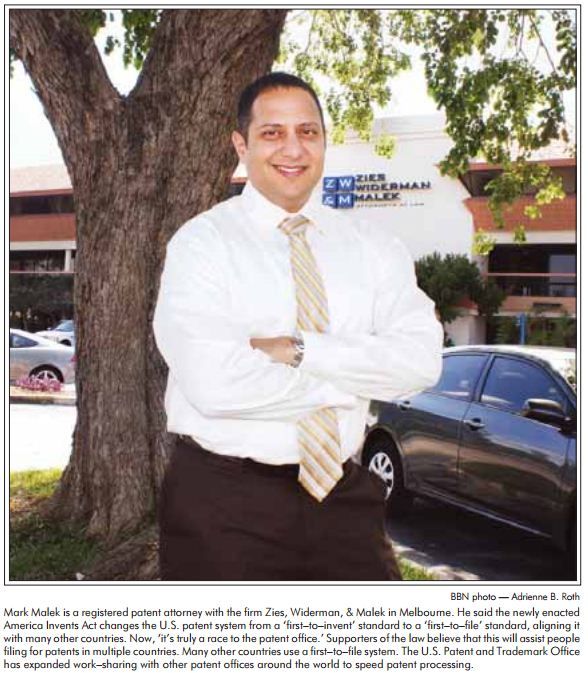
There are few government entities like the U.S. Patent and Trademark Office.
Beyond Wall Street, it is the rooted center of the universe of American capitalism. The office receives patent applications from entrepreneurs and businesses at the rate of more than 450,000 a year, with the majority filed electronically.
Some 6,000 examiners, generally scientists and engineers, review the applications, of which more than 150,000 a year are approved for patents.
As far as who can file to protect their invention, the patient office specifies only that the subject must be “useful.” The USPTO has granted more than 8 million patents since 1790.
These patented inventions help power the economy, in a big, sweeping way. Intellectual–property–intensive industries today support at least 40 million jobs and contribute more that $5 trillion to the U.S. gross domestic product, according to a U.S. Department of Commerce report